Distributed Systems End-to-End Security: Controls for APIs, Data, and Workloads
5. June 2026
The traditional network perimeter is becoming increasingly less important in modern IT environments. Today, applications, APIs, data, and workloads are distributed across cloud platforms, data centers, and SaaS services.
As a result, the focus of security is also shifting. The decisive factor is no longer solely whether something is located inside or outside a network, but rather who can access which resources – and how this access can be controlled and traced.
APIs must be protected, data access must be monitored, and workloads must be secured. Security controls must not stop at infrastructure boundaries but must be applied throughout the entire data flow.
The real challenge is not only to define control organizationally, but to enforce it technically. Anyone who can trace at any time which identities access which resources and which protection mechanisms are applied creates the foundation for a resilient security model.
Why Traditional Perimeter Security Fails in Distributed Systems
Firewalls and VPNs were built for a world in which resources were centralized and the network edge was clearly defined. In modern distributed architectures, this edge no longer exists: services communicate through APIs, workloads run in clouds from different providers, and identities are mobile.
Anyone who still adheres to the perimeter model is protecting a boundary that has long since disappeared. Security must be based on identity, not network location.
The Three Layers of Secure Infrastructure
Prevention, detection, and response are not optional. Anyone who focuses only on prevention will not notice attacks. Anyone who relies solely on detection without first systematically reducing the attack surface operates at a structural disadvantage – and usually loses slowly enough not to notice it for a long time.
Layer 1: Prevention – Systematically Reducing the Attack Surface
API Security: Where Attackers Prefer to Gain Entry
Programming interfaces connect modern systems. By definition, they are accessible – and that is precisely why they are the preferred point of entry. Organizationally, they often fall between teams. Technically, they are often exposed more broadly than necessary.
According to OWASP, two vulnerabilities have remained dominant for years:
- Excess Data Exposure: Interfaces return more data than is necessary for a request. An endpoint that returns the entire user object even though only the name is required increases the amount of exposed data without providing any functional benefit.
- Broken Object Level Authorization (BOLA): Authenticated users can access records belonging to others by manipulating record IDs – because authorization checks at the object level are missing, not because authentication is absent.
Both are architectural decisions that nobody consciously made.
Security rules do not belong in the business logic of individual services. They belong at the platform level. A central API gateway handles authentication, access restrictions, and input validation. A token that broadly permits everything is an open window with a lock mounted on the outside.
Data Encryption in the Cloud: Three States, One Blind Spot
Data exists in three states. Most security concepts address only two of them.
At rest – stored data: Encryption protects against the physical loss of storage media, not against an attacker with active system access.
In transit – transmitted data: TLS based on current standards is non-negotiable. Outdated protocol versions in production environments are a well-known problem – and one that can be resolved with relatively little effort.
In use – data under active processing: Data must be decrypted for processing. At that moment, it becomes vulnerable. Hardware-based isolation mechanisms – known as Trusted Execution Environments (TEEs) – provide protection even in this state.
Zero Trust Architecture as an Architectural Principle
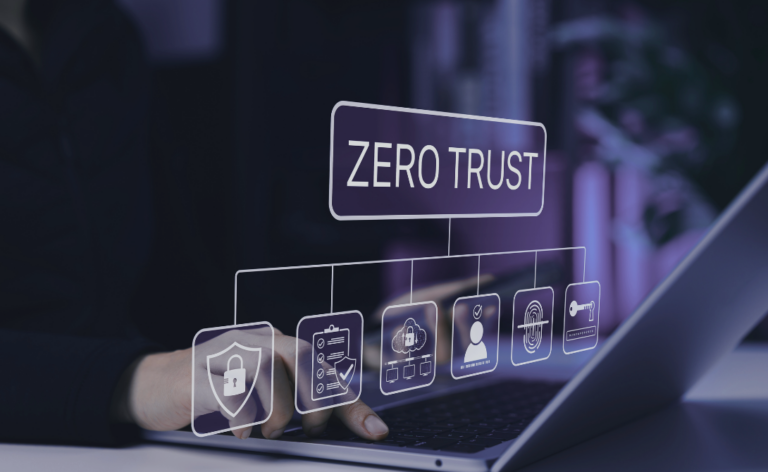
Zero Trust means: no process, user, or system receives trust solely based on its network position. Every access request is explicitly authorized, continuously verified, and granted with minimum privileges. Identity becomes the central control instance – for people as well as technical services.
In containerized environments, this means explicit communication rules between services, securely managed credentials, and automated security checks directly within the development process. A misconfigured resource fails during validation – not during an external security test.
Layer 2: Detection – Seeing What Happens in Your Infrastructure
Prevention alone is not enough. An attacker who gains entry despite all controls leaves traces – but only if those traces are recorded and understood.
Requests spanning multiple services must be traceable. A service that suddenly establishes ten times more outbound connections than usual is a signal – regardless of whether the protocol being used is known.
Behavior-based detection outperforms signature-based detection when it comes to new attack methods. Known attack patterns can be looked up. Unknown attacks can only be identified through a precise understanding of normal behavior – one that is continuously built and maintained.
Layer 3: Response – Damage Limitation as an Architectural Decision
Even with high security standards, risks cannot be completely eliminated. The question is how quickly an incident is detected – and how much damage occurs before then.
Three design principles structurally limit this damage:
01 / Least Privilege: A compromised process can only do what it is authorized to do – not everything that is technically possible.
02 / Network Segmentation: Keeps an attack local instead of allowing it to spread uncontrollably. Anyone operating everything within a flat network has no built-in damage containment – only a matter of time before lateral movement occurs.
03 / Threat Modeling During the Design Process: Structured thinking about attack vectors before the first line of code is written is less expensive than any subsequent correction.
Shared Responsibility Is Not an Excuse
In cloud and managed service environments, the provider defines what it secures. Everything else remains the operator’s responsibility. Anyone who has not clarified this explicitly has a gap in their security model – and usually discovers it only after someone else has found it.
Security Is an Architectural Decision
The attack surface cannot be reduced to zero. It can, however, be systematically minimized – through explicit rather than implicit trust relationships, encryption across all three states, visibility that makes security-relevant events detectable, and organizational clarity regarding responsibility for each part of the infrastructure.